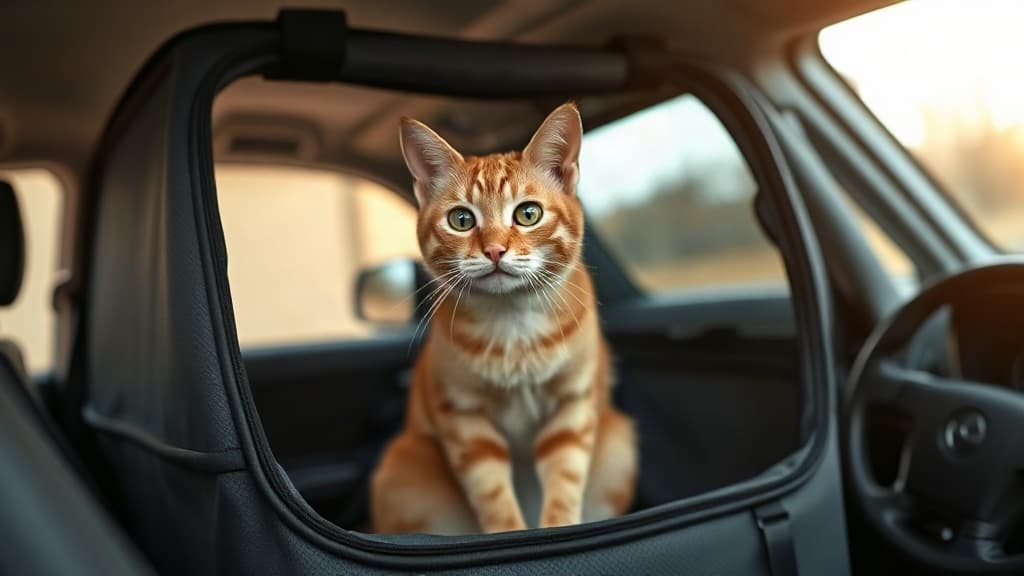
Whether it's a two-week vacation or a permanent move across town, taking a cat somewhere new challenges something deeply built into its biology. Cats are territorial animals whose sense of safety depends on familiar scent and routine, not on being near a particular person the way a dog's does. Research on two very different travel situations — car transport and adapting to an unfamiliar place — shows what actually helps, and what doesn't.
A territorial animal in a moving box
A cat's sense of security is anchored in scent markers it has built up over time: furniture, corners, doorframes, its owner's scent on the sofa. Taking a cat out of that territory — even for a few hours — removes almost every reference point at once. That's part of why both a car ride and a new house trigger a stress response, even though the two situations are quite different.
What actually reduces stress during car travel
A 2018 study in Applied Animal Behaviour Science tested whether carrier training makes a measurable difference. Researchers split 22 cats into a training group and a control group. The training group received 28 short sessions — about 8 minutes each, using treats — spread across 6 weeks, gradually building a positive association with the carrier and the car. The result: trained cats showed clearly fewer signs of stress during a 10-minute car ride, and the veterinary exam that followed went faster and more smoothly.
Leave the carrier out permanently as a piece of furniture, not something that only appears before a stressful trip
Feed treats and meals inside it so the carrier becomes associated with something good
Build the association gradually — door open, cat walking in and out freely, before ever closing it
Practice short car rides around the block long before a real trip is needed
A separate 2024 study in Animals tested a synthetic semiochemical (2-methyl-2-butenal) worn as a collar during a 70-minute transport. Cats wearing the treated collar had a lower heart rate, slept and self-groomed more, and — unlike the control group — did not hide, vomit, or drool excessively. Commercial calming pheromone sprays for carriers work on a similar principle and can be applied about 10–15 minutes before departure.
What happens when the destination itself is new
A 2015 study in the same journal looked at owned cats introduced to an unfamiliar room, combining behaviour scoring with measurements of stress hormone metabolites in the cats' faeces. Cats with higher stress scores spent significantly more time hiding, and stress levels were linked to age, sex, and whether the cat had previous experience of confinement. Importantly, extended, calm interaction with a familiar person measurably reduced the stress response over time.
The practical implication: a cat that hides for hours in a vacation rental or a new home isn't being difficult — hiding is a normal, healthy coping strategy while it gathers information about a space it can't yet read. Forcing a cat out to "help it adjust" tends to backfire.
Practical tips for both vacations and moves
Start carrier training weeks, not days, in advance — the Pratsch et al. study used a six-week programme
Bring familiar-smelling items — bedding, a blanket, a favourite toy — rather than washing everything before the trip
Set up one small base room immediately on arrival with litter box, food, water, and a hiding spot, before opening the rest of the space
Let the cat choose when to explore rather than carrying it around to "show it" the new place
Keep feeding and play times consistent even away from home
Consider a synthetic pheromone diffuser or spray a few days ahead of a move or a longer trip
The bottom line
A cat that resists the carrier or hides for the first day in a new place isn't being dramatic or stubborn — from a territorial animal's perspective, losing access to a scent-marked space is a legitimate signal to be cautious. Carrier training well before the trip and giving a cat time and a safe base once you arrive are the two most evidence-backed things an owner can do.
Sources: Pratsch L, Mohr N, Palme R, Rost J, Troxler J, Arhant C. Carrier training cats reduces stress on transport to a veterinary practice. Applied Animal Behaviour Science. 2018;206:64-74. DOI: 10.1016/j.applanim.2018.05.025 — Archer C, McGlone J. Semiochemical 2-Methyl-2-butenal Reduced Signs of Stress in Cats during Transport. Animals. 2024;14(2):341. DOI: 10.3390/ani14020341 — Rehnberg LK, Robert KA. The effects of social interaction and environmental enrichment on the space use, behaviour and stress of owned housecats facing a novel environment. Applied Animal Behaviour Science. 2015;169:51-61.